Look, buying a home in Queen Creek is exciting. You’ve got the keys, the open floor plan, and maybe a view of the San Tan Mountains if you’re lucky. But then you look out the back window. If it’s a new build, you’re probably staring at a square of leveled dust that tracks into the house every time the dog goes out. If it’s an older home, maybe you’re looking at a jungle of overgrown oleanders or a patch of grass that’s seen better days. It can feel a little overwhelming, right?
Honestly, most homeowners feel a mix of excitement and total confusion when it comes to the yard. You want it to look like a resort, but you don’t want to spend every Saturday morning fighting with a lawnmower in 110-degree heat. That is where residential landscaping stops being just about planting flowers and starts being about lifestyle design. It’s about creating a space where you actually want to hang out. Let’s walk through the basics of turning that patch of Arizona dirt into something you can be proud of.
Contents
- 1 Start With a Plan, Not a Shovel
- 2 The Dirt on Queen Creek Soil
- 3 Selecting the Right Plants (Xeriscaping Done Right)
- 4 Hardscaping: Expanding Your Living Space
- 5 Water: The Lifeline of Your Landscape
- 6 Turf: To Grass or Not to Grass?
- 7 Lighting: Don’t disappear at Night
- 8 Maintenance Matters
- 9 Ready to Change Your View?
Start With a Plan, Not a Shovel
Here is the biggest mistake people make: they drive down to the big box store on a Saturday, buy a bunch of plants that look pretty in the pot, and stick them in the ground. Three months later? Those plants are crispy, brown sticks.
Before you buy a single bag of mulch, you need a plan. In the industry, we call this the Landscape Design phase. But let’s keep it simple. You need to figure out how you’re going to use the space. Are you the type to host massive BBQs? Do you need a safe stretch of turf for the kids or the dog? Or are you just looking for a quiet spot to drink coffee before the sun gets too high?
Think of your yard in zones. You have your hardscape—that’s the permanent stuff like patios, walkways, and retaining walls—and your softscape, which covers the living stuff like trees, shrubs, and turf. Getting the balance right is everything. If you have too much concrete, your yard feels like a parking lot. Too many plants, and you’ve just signed up for a part-time job as a gardener.
The Dirt on Queen Creek Soil
Let’s be real for a second about what we are working with. The soil here in Queen Creek can be… challenging. We often deal with heavy clay or that rock-hard layer known as caliche. If you’ve ever tried to dig a hole here and hit a layer of white, chalky stuff that feels like concrete, that’s caliche.
You can’t just ignore the soil conditions. If you plant a tree in a hole surrounded by caliche without proper drainage, you’re essentially planting it in a bathtub. The water sits, the roots rot, and the tree dies. It’s heartbreaking (and expensive).
Soil preparation is the unsexy part of landscaping that matters the most. We often have to amend the soil with organic material to help with drainage and nutrients. It’s like giving your plants a fighting chance before they even start growing. Sometimes, we even have to build up, using mounds or raised planters, to bypass the hard ground entirely. It adds depth to the yard, visually, and keeps the plants happy.
Selecting the Right Plants (Xeriscaping Done Right)
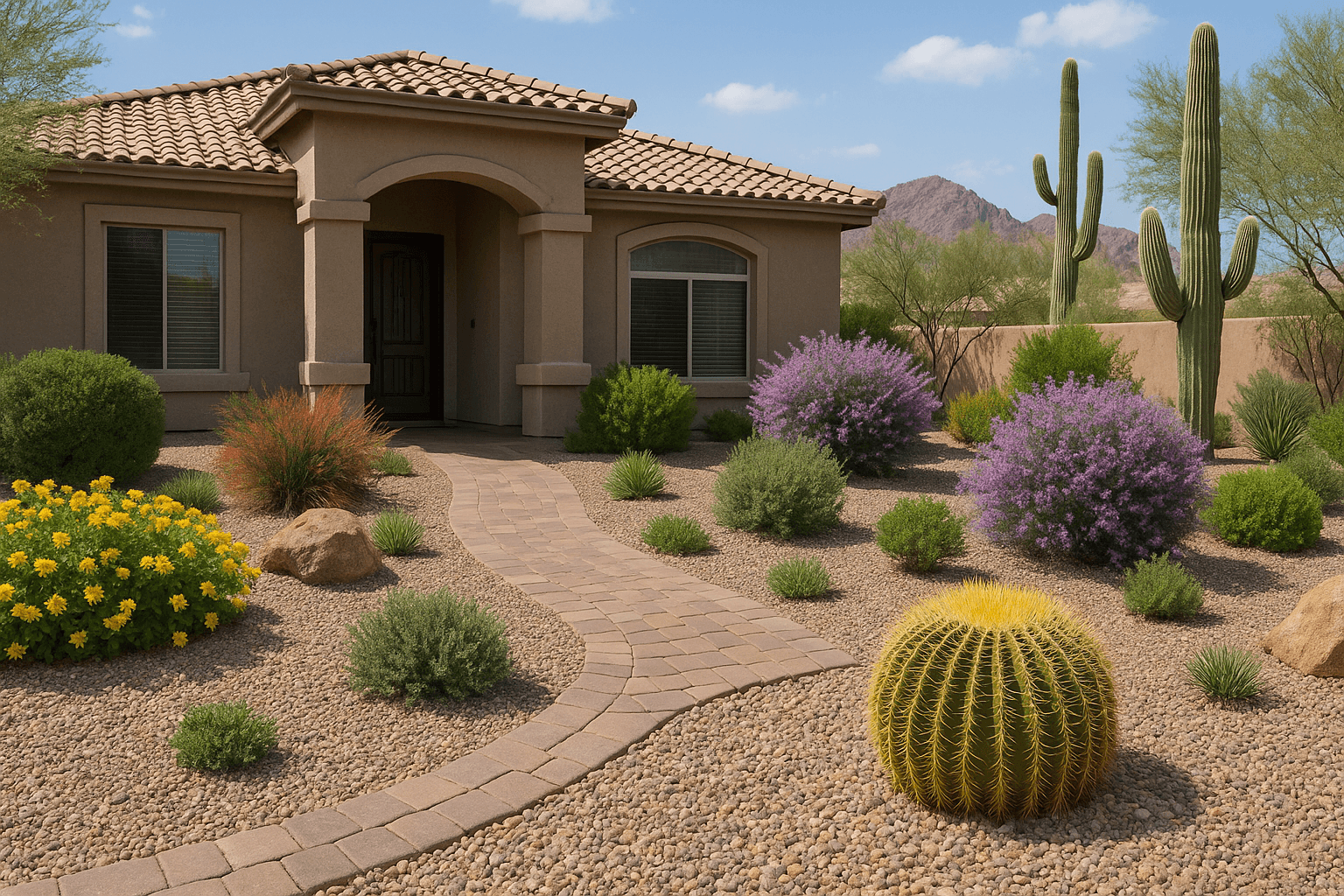
There is a misconception that “desert landscaping” means a yard full of gravel and a single lonely cactus. That is old school. Modern desert landscaping, or xeriscaping, can be lush, colorful, and incredibly vibrant. It’s all about putting the right plant in the right place.
We live in a unique climate. Plants here need to be tough. They need to handle the scorching July sun and the occasional January freeze. But that doesn’t mean they have to be boring.
Here are a few categories we like to mix and match:
- Native Trees: Think Mesquite or Palo Verde. They provide that dappled shade which is crucial for protecting other plants (and your patio).
- Flowering Shrubs: Texas Sage (with those purple blooms when it rains) or Red Yucca. They add pops of color that break up the browns and greens.
- Accents: Agaves and Aloes. These are architectural plants; they look like living sculptures.
You know what? Using native plants isn’t just about saving water—though that is a huge bonus. It’s about maintenance. Native plants want to be here. They don’t need to be babied. You aren’t fighting nature; you’re working with it.
Hardscaping: Expanding Your Living Space
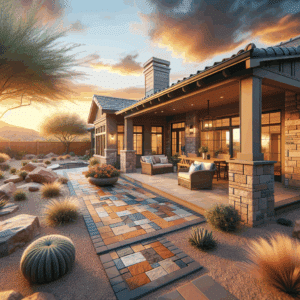
In Arizona, we treat the backyard like an extra room of the house. This is where hardscape installation comes into play. Since we can’t exactly grow a lush English garden floor, we use pavers, travertine, and concrete to create usable surfaces.
Travertine is a massive favorite around here, and for good reason. It’s a natural stone that stays relatively cool underfoot compared to concrete pavers. If you have kids running around barefoot or you’re stepping out of a pool, that temperature difference matters.
We also need to talk about shade. The sun is aggressive. Pergolas, gazebos, or solid roof extensions are almost mandatory if you plan on using the yard before sunset. It creates a focal point and gives you a reason to go outside. Imagine a nice paver patio with a fire pit for the winter and a shade structure for the summer. Suddenly, your square footage just increased because you’re actually using the outdoors.
Water: The Lifeline of Your Landscape
You can have the best design and the most expensive plants, but if your irrigation system is trash, none of it matters. In Queen Creek, you cannot rely on the rain. We might get a monsoon dump one afternoon and then nothing for three months.
An automated drip irrigation system is standard. It delivers water directly to the base of the plant, minimizing evaporation. But here is the thing technology has changed the game. We now use “smart” irrigation controllers. These things are brilliant. They connect to local weather stations via Wi-Fi.
Did it rain last night? The system knows and skips the watering cycle. Is a heatwave coming? It adjusts to give the plants a little extra drink. It saves you money on your water bill and prevents that common issue of over-watering or under-watering. It takes the guesswork out of it.
Turf: To Grass or Not to Grass?
This is the big debate. Everyone loves the look of a green lawn, but keeping natural grass alive in Arizona is a labor of love (and water).
Many homeowners are switching to Artificial Turf. Listen, the fake grass of twenty years ago looked like green plastic carpet. The new stuff? It’s impressive. It has thatch layers, varied blade colors, and feels soft. It stays green year-round, requires zero water, and you never have to mow it.
However, some people just love the smell of fresh-cut grass and the cooling effect natural sod provides. If you go with natural sod, we usually recommend a Bermuda hybrid for the summer because it loves the heat. Just be prepared for the transition period in the winter when it goes dormant, unless you overseed with Rye. It’s a choice between convenience and tradition.
Here is a quick breakdown to help you decide:
| Feature | Natural Sod | Artificial Turf |
|---|---|---|
| Maintenance | High (mowing, fertilizer) | Very Low (rinsing, brushing) |
| Water Use | High | None |
| Heat | Stays cool | Can get hot in direct sun |
Lighting: Don’t disappear at Night
A lot of people forget about lighting until the project is done, but it makes a huge difference. Landscape lighting isn’t just about security (though it helps); it’s about ambiance.
Low-voltage LED lights can highlight that beautiful Mesquite tree you just planted or light up the walkway so you don’t trip carrying the burgers to the table. It adds a level of sophistication to the property. When you look out your window at night, you don’t want to stare into a black void. Seeing the soft glow on the plants makes the home feel larger and more inviting.
Maintenance Matters
I wish I could tell you that you can install a landscape and never touch it again, but nature doesn’t work that way. Even low-maintenance yards need a little love.
Trees need pruning to keep their structure strong against monsoon winds. Irrigation emitters get clogged with our hard water and need swapping out. Weeds… well, weeds are relentless. They will find a way to grow in the crack of a sidewalk if given half a chance.
Having a Landscape Maintenance plan, whether you do it yourself or hire a crew, is vital to protecting your investment. You don’t want to spend thousands on a beautiful install only to let it get overgrown and messy a year later.
Ready to Change Your View?
It’s a lot to think about, isn’t it? From soil pH to paver patterns, landscaping is more science and art than just digging holes. But you don’t have to figure it out alone. You deserve a yard that makes you smile every time you pull into the driveway.
At Red Mountain Landscaping, we know Queen Creek. We know the soil, the climate, and how to build outdoor spaces that last. Whether you are starting from a blank dirt lot or trying to rescue an old yard, we are here to help.
Let’s get that project started.