
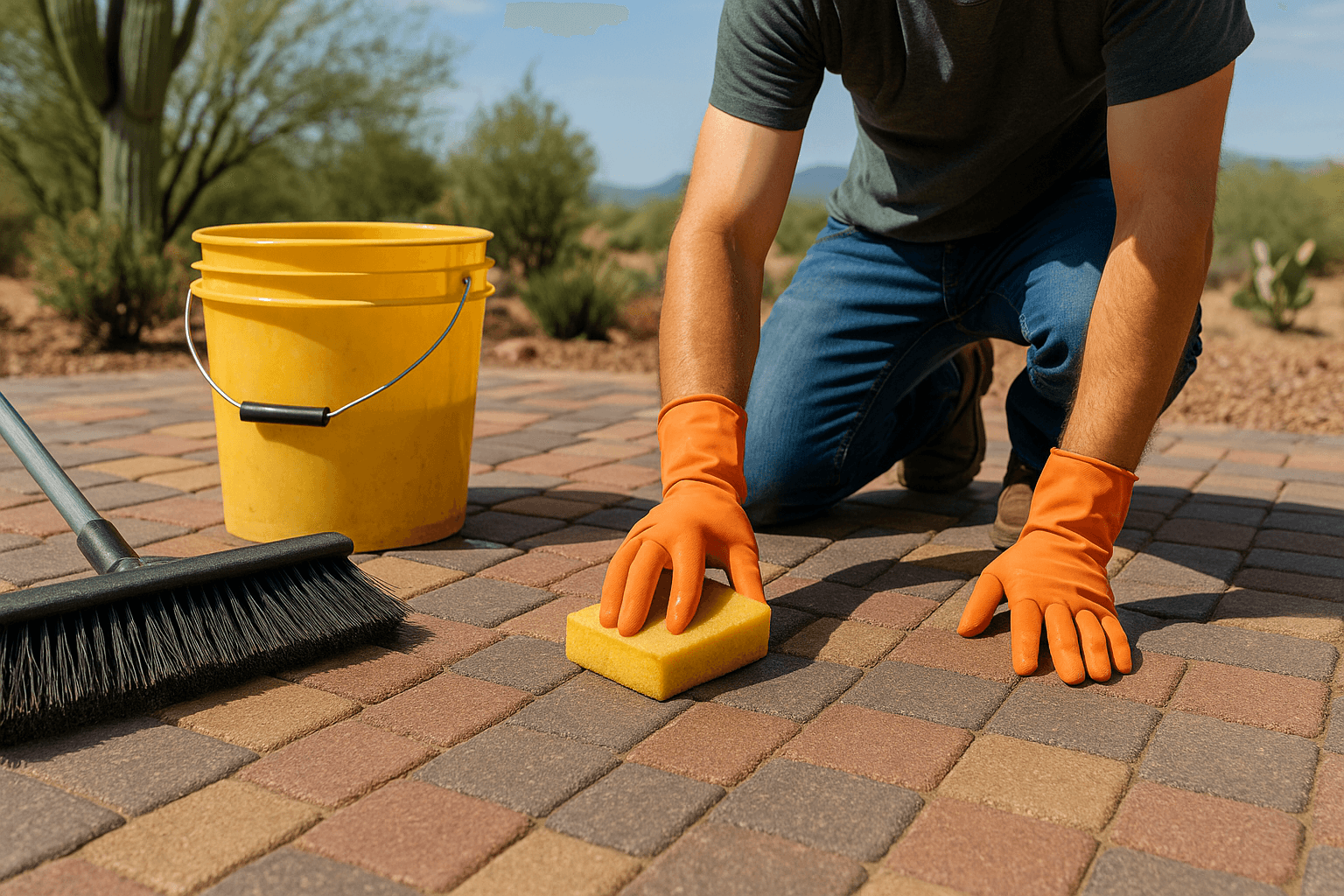
There’s something special about walking out onto your patio first thing in the morning with a cup of coffee. The air is still cool, the sun is just starting to hit the Superstition Mountains, and everything feels right. You look down at those pavers you had installed a while back—maybe it’s a driveway that welcomes you home or a pool deck where the kids spend all summer—and you want them to stay looking that good forever. But here’s the thing: even the best hardscapes need a little love.
Living here in Queen Creek, we deal with some unique challenges. Between the intense UV rays beating down in July and those massive monsoon dust storms that coat everything in a layer of brown, your outdoor spaces take a beating. It’s not just about aesthetics; it’s about protecting your investment. You wouldn’t buy a car and never change the oil, right? Same logic applies here. Maintaining your pavers isn’t overly complicated, but you do need to know what you’re doing to avoid making things worse.
Contents
Let’s Start with the Basics: Keep it Clean
You know what? The simplest advice is usually the best. Routine cleaning is the backbone of paver maintenance. It’s easy to let it slide, especially when life gets busy, but letting dirt and debris sit on your pavers is asking for trouble. Organic material like leaves or dropped flower petals can break down and actually stain the concrete. Plus, in our area, if you let dirt pile up in the joints, you’re basically building a nursery for weeds.
For most weeks, a good stiff broom is your best friend. Sweeping doesn’t just make it look tidy; it keeps the surface coarse and safe for walking. If you’ve got a hose, giving it a spray down helps too. Just don’t go crazy with the high-pressure nozzle every single week. You want to wash the dirt off the pavers, not blast the sand out from between them.
The Pressure Washer: Friend or Foe?
Speaking of water pressure, let’s talk about pressure washers. It’s satisfying, isn’t it? blasting away months of grime. But honestly, you have to be careful. If you use too much pressure or hold the nozzle too close, you can actually damage the surface of the paver, exposing the aggregate underneath. It changes the texture and can make them look worn out way faster than they should.
Tips for safe washing:
- Keep your distance: Hold the nozzle at least 12 inches away from the surface.
- Use a fan tip: Never use the zero-degree (pencil point) nozzle. It’s too aggressive.
- Watch the joints: Try to avoid spraying directly into the cracks, or you’ll send your joint sand flying all over the yard.
If you aren’t comfortable doing it yourself, or if the grime is really stuck on there, it might be time to call in a professional. We have the equipment to clean deeply without tearing things up.
Dealing with Stains: BBQ Grease, Oil, and Rust
We love our outdoor kitchens in Arizona. But eventually, someone is going to drop a burger, or a car is going to leak a little oil on the driveway. Concrete pavers are porous—think of them like a hard sponge. If liquid sits on them, it soaks in.
Speed is the name of the game here. The faster you catch it, the easier it is to fix.
| Type of Stain | The Fix | Pro Tip |
|---|---|---|
| Oil or Grease | Soak it up with kitty litter or sawdust immediately. Then use dish soap (like Dawn) and hot water. | Scrub with a plastic bristle brush, not metal. Metal can scratch. |
| Rust | Commercial rust remover safe for concrete. Lemon juice can work on minor spots. | Test a small, hidden area first to make sure it doesn’t discolor the paver. |
| Efflorescence (White Haze) | This is natural salt coming to the surface. Often washes away with rain or mild cleaners. | Don’t stress. It usually resolves itself over time as the pavers cure. |
The War on Weeds
Here is the question we get asked most often: “Why are weeds growing in my patio?”
It’s annoying, right? You spend good money on a beautiful hardscape, and suddenly little green intruders are popping up. A common misconception is that the weeds are growing from under the pavers. In reality, that almost never happens if the base was installed correctly. What’s actually happening is that dirt and seeds blow into the joints from the top. When the monsoons hit, those seeds germinate in the sand between the stones.
So, how do you stop it?
Keep the joints full of sand (more on that in a second). If there is no room for dirt to settle, seeds can’t take root. If weeds do pop up, spot treat them immediately with a water-based herbicide or even just boiling water if you want to keep it chemical-free. Just don’t pull them by hand if you can help it—yanking them usually pulls the sand out with the roots, creating a bigger hole for the next weed.
Sealing: The Sunscreen for Your Hardscape
Let me explain why sealing matters so much in Queen Creek. Our sun is relentless. Over time, UV rays break down the pigments in the concrete, causing those rich reds, browns, and terracottas to fade into a washed-out gray.
Sealing your pavers does three main things:
- Enhances Color: It can give you that “wet look” that makes the colors pop, or a natural finish that just protects without the shine.
- Stabilizes Sand: A good sealer acts like a glue for the joint sand, hardening it so it doesn’t blow away or wash out. This is your best defense against weeds and shifting.
- Stain Protection: Remember that sponge analogy? Sealer fills the pores so oil and wine stay on the surface where you can wipe them up.
We usually recommend resealing every 3 to 5 years, depending on the exposure. It’s a process that involves deep cleaning, sanding, and applying the chemical coat. It’s hard work, but the result is a driveway or patio that looks brand new again.
Don’t Forget the Joint Sand
The sand between your pavers isn’t just filler; it’s structural. It creates “interlock,” which is the friction that keeps the pavers from rocking back and forth or rubbing against each other. When that sand disappears—from rain, wind, or over-aggressive sweeping—the pavers lose their stability.
We use polymeric sand for most projects. It’s a mixture of graded sand and a binder (polymer). When you sweep it in and wet it down, it activates and hardens almost like a flexible mortar. It’s tough enough to stop ants from burrowing through it and durable enough to withstand the rain, but flexible enough that the pavers won’t crack when the ground settles.
If you notice deep gaps between your pavers, it’s time to top it off. But be warned: using polymeric sand can be tricky. If you leave dust on the surface of the pavers and then wet it, you’ll end up with a hazy, glued-on mess that is a nightmare to remove. This is one of those tasks where professional help often saves you a headache.
When Things Move: Repairs
Even with the best care, the ground moves. We have soil in Arizona that likes to expand and contract. Sometimes, you might notice a section of your driveway sinking (we call it “subsidence”) or a paver getting pushed up by a tree root.
The beauty of pavers, compared to a solid concrete slab, is that they are zipper-able. You can remove a section, fix the base underneath, and put the same stones back. No ugly patch marks. If you catch a low spot early, it’s a quick fix. If you leave it, water pools there, soaks the base, and makes the hole get bigger and bigger.
Let Us Do the Heavy Lifting
Look, enjoying your backyard is the goal. Spending your entire weekend scrubbing and sanding probably isn’t. You’ve got better things to do in Queen Creek than worry about joint sand and sealer types.
At Red Mountain Landscaping, we know exactly what local homes need to stand up to the desert elements. Whether you need a deep clean and reseal to bring an old patio back to life, or you’re looking to install a brand new outdoor living space, we’ve got you covered. We handle the dirty work so you can get back to that morning coffee on the patio.
Ready to make your pavers look brand new again?
Request a Free Quote today or give us a call at 480-373-9312. Let’s get your yard looking its best.