Look, looking out at your backyard in Queen Creek might feel a bit daunting right now. Maybe you just bought a new build and you’re staring at a square of flat, brown dirt that looks more like the surface of Mars than a future oasis. Or maybe you’ve been in your home for a few years, but that one corner of the yard has defeated every single plant you’ve tried to put there.
We get it. Starting a garden here isn’t like starting one in Ohio or Oregon. You can’t just throw some seeds in the ground, wait for rain, and expect a lush paradise. The desert plays by its own rules. But here’s the thing: once you understand those rules, gardening in Arizona is incredibly rewarding. There is something deeply satisfying about coaxing life out of this rugged terrain. It’s about working with the environment rather than fighting a losing battle against it. Whether you want a vibrant xeriscape, a patch of green turf for the dog, or a few citrus trees to make your morning juice, building an Arizona garden from scratch is totally doable if you have a plan.
Contents
- 1 First, Let’s Talk About the Sun (It’s Not Just About Heat)
- 2 The Dirt on Queen Creek Soil
- 3 Water: The Lifeline of Your Garden
- 4 Picking Your Players (The Plants)
- 5 The “When” Matters as Much as the “What”
- 6 Mulch: The Sunscreen for Your Soil
- 7 Patience is a Virtue (Especially Here)
- 8 Don’t Forget the Hardscape
- 9 So, Where Do You Start?
First, Let’s Talk About the Sun (It’s Not Just About Heat)
Before you even think about buying a shovel, you need to grab a cup of coffee and just sit outside. Seriously. You need to watch the sun. In Queen Creek, the sun isn’t just a source of light; it’s a physical weight.
You have to understand your home’s “microclimates.” This is a fancy way of saying that the north side of your house is a completely different world than the west side. The west-facing wall? That’s an oven in the afternoon. Anything you plant there needs to be tough as nails. We’re talking cacti, agave, or ironwood trees. On the flip side, your east-facing areas get that gentle morning light but escape the scorching afternoon rays. That’s prime real estate for plants that need a little babying.
If you skip this step, you’ll end up with what we call “crispy critters”—plants that looked great in the nursery but turned into tumbleweeds within a week.
The Dirt on Queen Creek Soil
Okay, let’s be honest. The soil here can be frustrating. You might have noticed that when you try to dig, you hit a layer that feels like concrete. That’s likely caliche. It’s a natural cement-like layer of calcium carbonate found in soils of the arid Southwest. If you plant a tree right on top of a thick layer of caliche without breaking through it, the roots have nowhere to go, and the water won’t drain. It’s basically like planting your tree in a bathtub without a drain plug. Eventually, the roots rot.
But it’s not all bad news. The clay-heavy soil common in our area is actually rich in minerals. It just needs help with structure. You can’t just dig a hole and drop a plant in. You need to amend the soil.
When we prepare a site, we aren’t just moving dirt around. We are usually mixing in organic material—compost or forest mulch—to break up that clay and improve drainage. It allows the roots to breathe. If you are doing this yourself, don’t skimp on the soil prep. It is the unsexy part of gardening that matters the most.
Water: The Lifeline of Your Garden
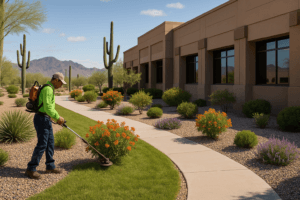
You might be thinking, “I’ll just water it with the hose.” But let me stop you right there. In Arizona, hand-watering is a recipe for disaster (and a really high water bill). The evaporation rate here is so high that surface watering often disappears before it reaches the deep roots.
To have a successful garden, you need a solid drip irrigation system.
A drip system delivers water slowly and deeply, right to the root zone where it’s needed. This encourages plants to send their roots down deep, which makes them more resilient when July rolls around and the temperatures hit 115 degrees.
Setting Up Zones
Here is a mistake we see a lot: people put everything on the same valve. You shouldn’t water your cactus on the same schedule as your citrus trees. They have different needs!
* Trees need deep, infrequent watering.
* Shrubs need water a bit more often but still deep.
* Flowers and veggies need frequent, shallower watering.
* Pots dry out faster than anything else.
If you put them all on one line, you’re either going to drown the cactus or starve the citrus.
Picking Your Players (The Plants)
This is the fun part, right? But it’s also where people get into trouble. You walk into a big box store garden center, and you see these beautiful hydrangeas or tropical ferns. They look amazing. But you have to ask yourself: “Is this plant confused about where it is?”
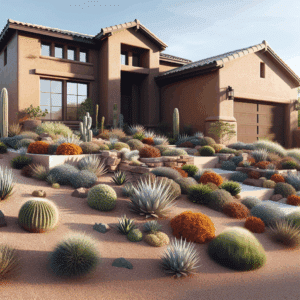
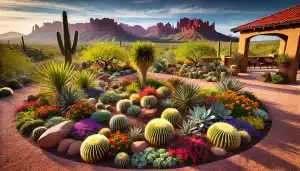
For a low-maintenance, high-success garden, you want to stick to native or desert-adapted plants. These are plants that evolved to survive droughts and intense sun. They don’t just survive here; they thrive.
| Plant Category | Why It Works | Local Favorites |
|---|---|---|
| Trees | Provides shade, cools the yard, anchors the design. | Palo Verde, Mesquite, Ironwood |
| Shrubs | Adds color and fills space. Tough as nails. | Texas Sage, Red Bird of Paradise, Valentine Bush |
| Accents | Architectural interest and texture. | Agave, Ocotillo, Yucca |
Does this mean you can’t have roses or a vegetable garden? Absolutely not. You just have to place them correctly (remember that morning sun we talked about?) and be prepared to give them a little extra love.
The “When” Matters as Much as the “What”
Timing is everything. If you decide to plant a new garden in the middle of June, you are basically sentencing those plants to a trial by fire. The ground is hot, the air is dry, and the plant will go into shock.
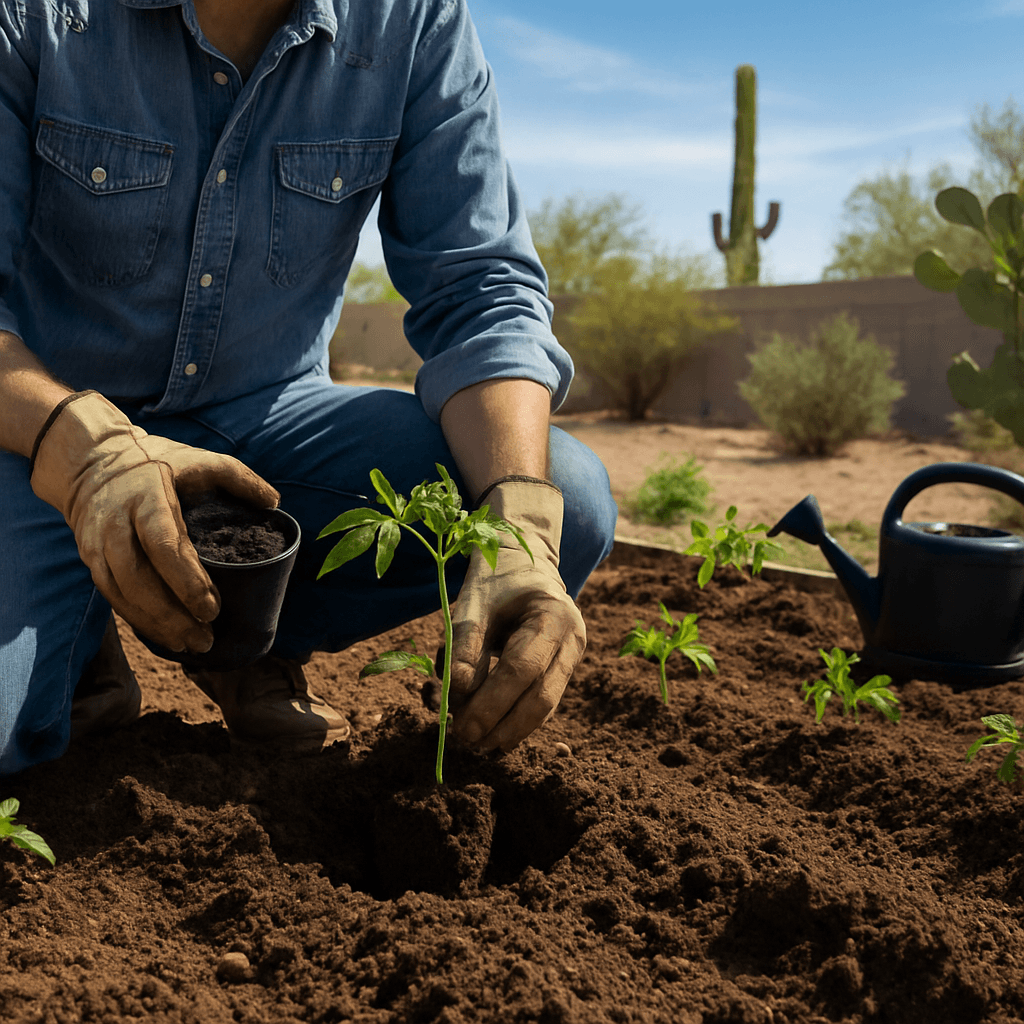
The best time to plant in Queen Creek is typically in the fall (October or November) or early spring (February or March). Planting in the fall is actually a secret weapon. The air is cooler, but the soil is still warm, which encourages root growth. The plants then have several months to get established before the summer heat hits. If you plant in spring, you’re racing against the clock to get roots established before the triple digits arrive.
Mulch: The Sunscreen for Your Soil
You know how you shouldn’t go out in the Arizona summer without sunscreen? Your soil is the same way. Bare soil dries out incredibly fast.
We always recommend covering the soil around your plants with a layer of inorganic mulch (like decomposed granite or crushed rock). This does three things:
- It keeps the moisture in the ground longer.
- It keeps the soil temperature slightly cooler.
- It suppresses weeds (and trust me, weeds will find a way).
Some people prefer organic mulch (wood chips) for trees and flower beds, which is great because it breaks down and feeds the soil. But for a typical desert landscape look, rock is the standard. It just looks clean, you know?
Patience is a Virtue (Especially Here)
Here is something not enough people talk about: the “sleep, creep, leap” phase.
When you first plant a perennial or shrub, the first year it sleeps. It doesn’t look like it’s doing much because all the energy is going underground to build roots. The second year, it creeps—you see a little growth. The third year? It leaps. Suddenly that tiny Lantana is taking over the sidewalk.
Don’t get discouraged if your garden doesn’t look like a magazine cover three months after planting. Landscaping is a long game. It evolves.
Don’t Forget the Hardscape
A garden isn’t just plants. In Queen Creek landscaping, the hardscape—pavers, travertine, fire pits, retaining walls—provides the bones of the design. Because we have such great weather for eight months of the year, your outdoor space is essentially an extra living room.
Think about flow. How do you get from the back door to the grill? Where do you want to sit to watch the sunset over the San Tan Mountains? Hardscape defines these spaces. Plus, a nice paver patio doesn’t need water, which is a huge bonus.
So, Where Do You Start?
It feels like a lot, doesn’t it? You have to test the soil, map the sun, run the PVC pipe for irrigation, pick the plants that won’t die, and then actually dig the holes. It’s sweaty work, and if we’re being honest, it can be pretty complicated to get the engineering of the drainage and irrigation right.
Sometimes, you just want the result without the backache. You want to walk out into a backyard that feels like a resort, not a construction project.
That’s where we come into the picture. At Red Mountain Landscaping, we know the dirt in Queen Creek. We know which plants survive the frost in January and the heat in July. We handle everything from the initial 3D design to the final layer of granite, ensuring your irrigation is efficient and your drainage is sound.
Why struggle with a shovel and a guess? Let us help you build a space you’ll love for years to come.