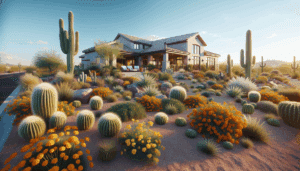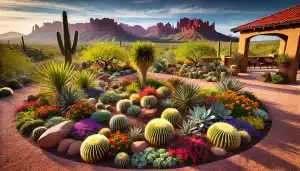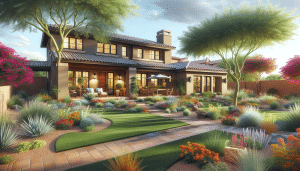
Let’s be real for a second. If you’ve bought a new home in Queen Creek recently, or even if you’ve been here a while, you’ve probably noticed something about the lot sizes. They aren’t exactly sprawling ranches anymore. We’re seeing a lot of what I call “postage stamp” backyards. But here’s the thing—having a smaller footprint doesn’t mean you have to sacrifice that amazing Arizona outdoor lifestyle. In fact, some of the most stunning, cozy, and inviting spaces we’ve worked on at Red Mountain Landscaping have been in yards that felt barely big enough to park a truck in.
You know what? There is actually a massive upside to a compact yard. Less maintenance. Less water. Less time spent weeding and more time spent sipping something cold while the sun goes down behind the San Tan Mountains. It’s about being smart with the square footage you have. It’s not about how much space you have; it’s about how you use it.
Contents
The “Room” Concept: Breaking Up the Box
When you look out your sliding glass door and just see a rectangle of dirt or a small slab of grey concrete, it can feel limiting. The trick to making a small space feel huge is zoning. It sounds fancy, but it’s just breaking the area into distinct little “rooms.”
Think about the inside of your house. You don’t do everything in one giant empty hall, right? You have a spot for eating, a spot for lounging, and maybe a spot for cooking. We apply that same logic outside. For a small Queen Creek backyard, we might designate one corner specifically for a bistro set—that’s your morning coffee spot. Then, shifted slightly to the center or the opposite side, we place a couple of deep-seating chairs or a small loveseat.
By using different hardscaping materials or simply changing the pattern of the pavers, we can visually separate these areas. It tricks the eye. Suddenly, your 15×20 yard feels like it has multiple destinations.
Angles Are Your Best Friend
Here is a little pro tip that designers use all the time. If you lay your patio square with the house, it emphasizes the boxiness of the yard. It essentially draws a line that says, “Look, the fence is right there.”
Instead, we love using diagonal lines or curves. Turning a patio layout 45 degrees creates a sense of expansion. The long lines of the pavers draw your eye to the farthest corners of the yard, rather than straight to the back fence. It’s a subtle optical illusion, but man, does it work.
Or, we can introduce organic, curved edges. A free-form paver patio softens the harsh lines of block walls. It feels more natural, more like a desert oasis and less like a concrete box.
Let’s Talk Surface Materials (Because It Gets Hot Here)
We have to address the elephant in the room: the heat. In Queen Creek, we deal with serious temperatures. If you have a small space, you likely have less airflow than a massive estate, which means heat can get trapped.
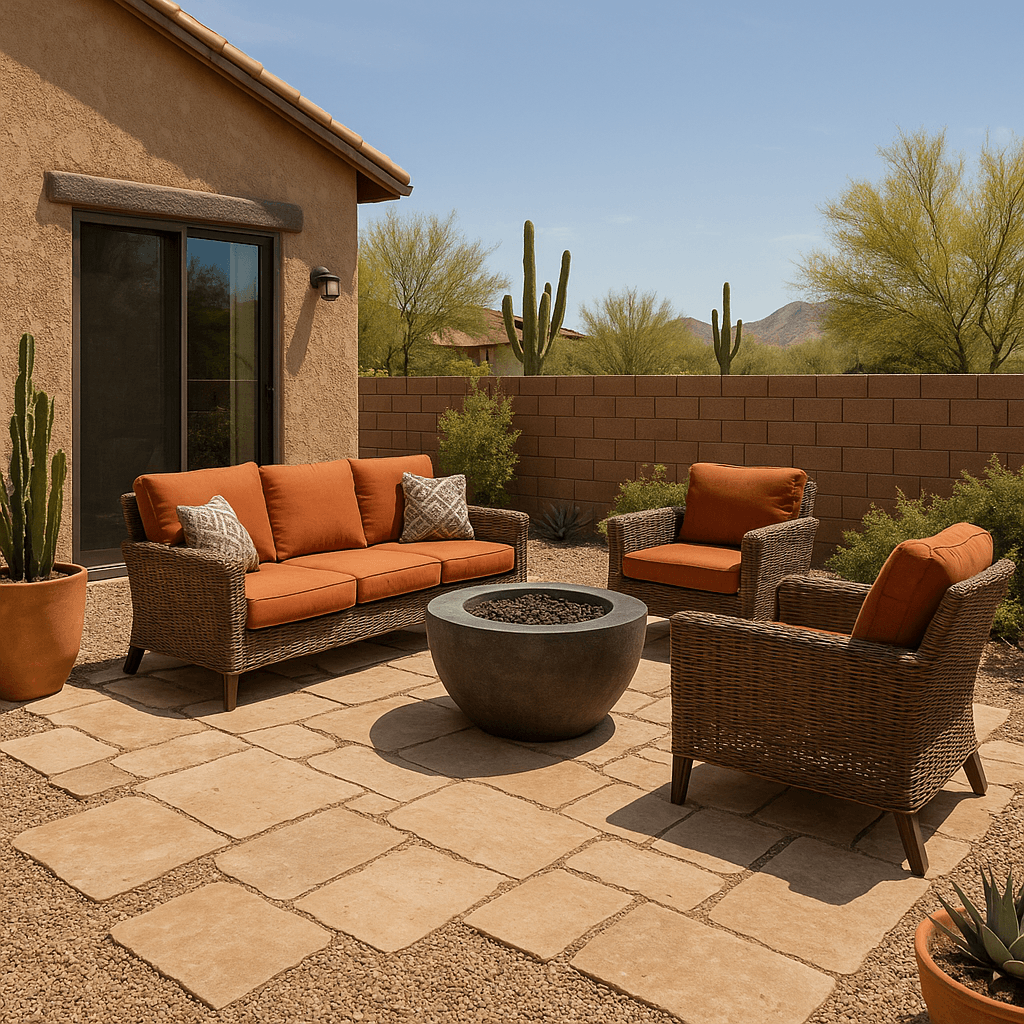
Material choice isn’t just aesthetic; it’s functional. Dark concrete? Forget about it. You’ll fry an egg on it, and your feet won’t be happy either. We usually recommend Travertine pavers for small, intimate spaces. Travertine is a natural stone that stays surprisingly cool to the touch, even in mid-July. Plus, it brings that high-end, luxury resort vibe right to your back door.
If you prefer the look of concrete pavers, we stick to lighter tones—creams, tans, and light greys. These reflect the sun rather than absorbing it. And speaking of materials, don’t be afraid to mix in some textures. Using bands of river rock or gravel between pavers (we call this a “permeable” design) not only looks modern but helps with drainage during those crazy monsoon storms.
The Fire Pit Focal Point
You might think, “My yard is too small for a fire pit.” Honestly? It’s probably the best feature for a small yard. A fire feature acts as a natural anchor. It gives people a reason to gather in a circle, which is the most space-efficient way to seat a group.
For tight spaces, we usually skip the massive, wood-burning stone circles that take up ten feet of width. Instead, we look at sleek, linear gas burners or compact gas fire tables. They provide the ambiance without the smoke (which can be overwhelming in a small, walled-in yard) and they double as a table when the fire isn’t lit.
Picture this: A built-in bench seating wall along the perimeter of the patio, tucked against a planter. It saves space because you don’t need bulky chairs, and it faces a central fire table. It’s cozy, intimate, and perfect for chilly Arizona evenings.
Go Vertical, Not Horizontal
When you can’t build out, you build up. This is crucial for adding greenery without sacrificing floor space. In a small backyard Landscape Design, giant spreading trees might be out of the question because their root systems can mess with your foundation or patio.
Instead, we use columnar trees or trellises. Vines climbing up a wall or a sleek, modern pergola can provide that essential shade without eating up your walking room. A pergola also helps define that “ceiling” for your outdoor room, making it feel cozy rather than cramped.
Also, think about hanging planters or wall-mounted herb gardens. They add that lush, green texture—which softens all the rock and stone we have here in the desert—without taking up a single square foot of your patio.
Lighting: Setting the Mood
Lighting is the secret sauce. In a small space, you don’t need floodlights. Actually, you want to avoid them because they’ll wash everything out and make you feel like you’re in a prison yard.
We prefer low-voltage bistro lights (string lights) zig-zagging overhead. They create a warm, festival-like atmosphere. Combine that with some subtle uplighting on your perimeter plants or that vertical trellis we talked about. This creates depth. By lighting the edges of the yard, you push the visual boundary back, making the space feel larger at night.
Furniture Scale and Flow
This is where I see a lot of homeowners get stuck. They go to the big box store and buy the “Mega-Lounge Sectional” because it looked great in the showroom. Then they get it home, and suddenly nobody can walk to the BBQ grill without shin-kicking the ottoman.
Scale is everything. For small patio layouts, look for furniture with open frames (where you can see through the back and arms). It allows light and air to pass through, visually taking up less weight. Bistro tables, stackable chairs, or built-in bench seating are your allies here. You want to ensure there is a clear “traffic flow.” If you have to shuffle sideways to get around a table, the furniture is too big.
Bringing It All Together
It’s easy to look at a small patch of dirt and feel uninspired. But some of the best transformations happen in these cozy spaces. A small yard forces you to be intentional. Every paver, every plant, and every chair has a purpose. There is no wasted space.
Whether you want a quiet meditation corner with a small fountain (the sound of water drowns out neighborhood noise, by the way) or a social hub with a fire table and pavers, your small yard has massive potential. It just takes a little bit of creative vision and the right team to execute it.
If you are staring at your backyard wondering how to fit your dreams into a small footprint, stop guessing and let us help you map it out. We know the Queen Creek soil, the climate, and how to maximize every inch of your property.
Ready to transform your space?
Give us a shout. We’d love to walk your property and give you some ideas you probably haven’t even thought of yet.